BOOKS
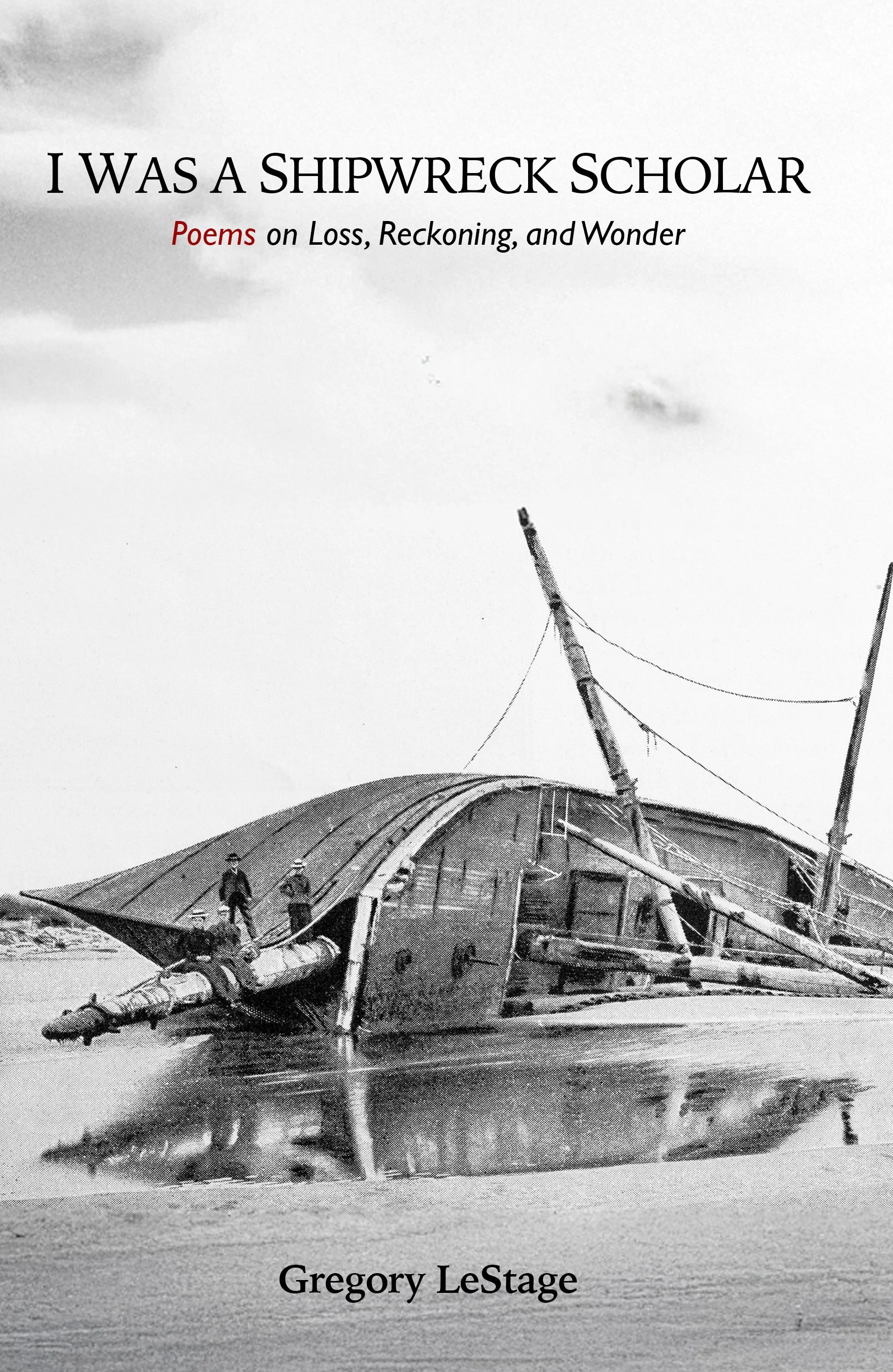
I Was A Shipwreck Scholar
With clarity, craft, and quiet power, Gregory LeStage’s new collection stands firm in the lineage of American poetry that confronts memory, loss, and manhood without flinching.
In I Was a Shipwreck Scholar, LeStage writes with the assured voice of someone who knows the terrain—of fathers and sons, of New England coastlines, of things hard-won and harder to hold. These poems are forged with precision and restraint, built like seawalls against time’s erosion. Whether reckoning with childhood, honoring the raw beauty of Cape Cod’s coastal life, or reflecting on the failures and redemptions of adulthood, LeStage writes with the restraint of a woodworker, the curiosity of a boy among tide pools, and the strength of a man who has learned to carry weight—and put it down again.
He moves fluidly between free verse and formal structures, crafting a villanelle like “Do Not Rush the Wound to Mending” or a sonnetlike meditation such as “Kingmaker’s Glass” with the same care and reverence he brings to restoring an old barn beam or rebuilding a seawall. These carefully patterned pieces are evidence of a long apprenticeship to the genre—a poet who understands that the architecture of a line can hold as much weight as the emotion within it.
These are poems that do not drift. They anchor. From the spare, architectural elegance of “Renting a Hopper House” to the mythic heft of “Shipwreck Scholar” and “The Kinship of Freefall,” this collection reclaims poetry as a tool for men who feel deeply, speak honestly, and build meaning word by word.
LeStage’s work reminds us that strength is not about certainty—it’s about standing still in the wind, eyes open, heart steady.
A fascinating, poignant, and triumphant collection…
— Alexander Larman | Poetry Editor, The Spectator | Author of Lazarus and The Crown in Crisis
After tenderly burying a seal carcass near his seaside home, Gregory LeStage imagines digging it up years later, wiring its bones, and hanging it so it “moves with the breeze off the bay / like a seal remembering itself.” That image captures I Was a Shipwreck Scholar as a whole: an earthy poet rearticulating his own life on and near the Cape, animating moments from lived experience that might otherwise decompose and disappear. It’s a gift, this restoration; each poem seems to shimmer hauntingly in the salty Cape Cod air.
— Eben Harrell | Senior Editor, Harvard Business Review
Gregory LeStage’s poems move like weather – clearing, darkening, flashing suddenly with revelation. They remember what the land and water remember: that loss and beauty are the same tide, returning. This is a book of startling poise and compassion, as tender as it is exacting.
— Daniel Johnson | Executive Director, Mass Poetry | Author of How to Catch a Falling Knife and Shadow Act: An Elegy for Journalist James Foley
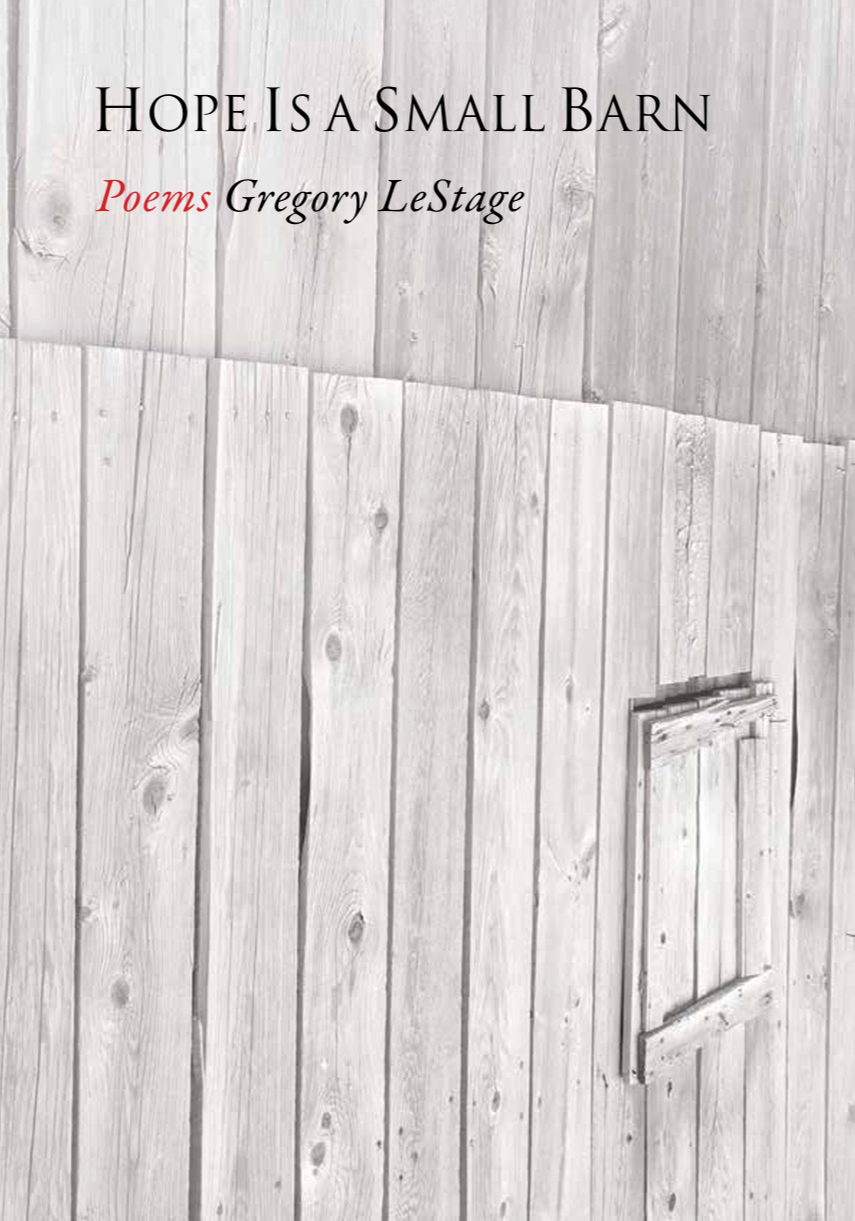
Hope Is A Small Barn
Finalist: Julia Ward Howe Poetry Prize
Vaclav Havel wrote that hope was not just optimism that things will work out well, but rather a faith that what we do makes sense, regardless of the outcome. For Gregory LeStage, hope includes a child’s freshness of perception as he goes forth to discover the world. Hope for this poet also includes a deep commitment to assay both joy and sorrow, especially as these are met in family life unfolding over time. Underneath these is the hope that the shaping of words to express intense feeling is in itself worth our while and meaning-full. If, as LeStage tells us, hope is a small barn with a “roof half open to the sky,” here are poems that are crafted like sturdy beams, weight-bearing, reliable, and true.
— Fred Marchant | Author of Said Not Said
In Hope Is a Small Barn, Gregory LeStage returns our poetry to sonic elegance. The music inheres in LeStage’s poems, from syllable to syntax, and builds, like Rilke’s Orpheus, “a temple in the ear.” Each of these poems is an embodiment, a shapely figure for the poet’s concerns, which are those of maturity: love and its responsibilities, mortality and its abiding questions. There is great nourishment to be found in these beautifully crafted poems.
— Richard Hoffman | Author of Gold Star Road
“Words matter” says poet Gregory LeStage in the preface to his newest book, Hope Is a Small Barn, and then proceeds to prove the point. Each word in this intelligent collection of poems is precisely placed, each carefully crafted for sound, associations, beats, even, once, to form a visual image on the page. The collection starts with the experiences of the poet as a boy of ten and then oscillates over and through his life, always returning “to someone we all once were /some child or safe self long gone.” This fine new book takes us deep into the mind of an accomplished poet as he struggles to “make my peace with all / that I could never understand / by reckoning through the archive of the inexplicable” Poetry at its best is, indeed, our struggle with the inexplicable. We are all the wiser for this poet's struggle and for the beautiful, thoughtful, poems that have flowed from it.
— Michael Ansara | Founder and Chairman of Mass Poetry
The poems in Gregory LeStage’s Hope Is A Small Barn refuse to accept easy answers to the all-important issues with which they deal. Nevertheless, they explore the human condition's most shared mysteries with an essential optimism that finds and reveals beauty in people and place. Hope is a lantern lit with words. As Fred Marchant notes, "Hope for this poet includes a deep commitment to assay both joy and sorrow, especially as these are met in family life unfolding over time. Underneath these is the hope that the shaping of words to express intense feeling is in itself worth our while and meaning-full. If, as LeStage tells us, hope is a small barn with a 'roof half open to the sky, ' here are poems that are crafted like sturdy beams, weight-bearing, reliable, and true." Richard Hoffman adds this: "In Hope Is a Small Barn, Gregg LeStage returns our poetry to sonic elegance. Each of these poems is an embodiment, a shapely figure for the poet's concerns, which are those of maturity: love and its responsibilities, mortality and its abiding questions.
There is great nourishment to be found in these beautifully crafted poems. Ant this praise from Michael Ansara: "Each word in this intelligent collection of poems is precisely placed, each carefully crafted for sound, associations, beats, even, once, to form a visual image on the page. This fine new book takes us deep into the mind of an accomplished poet as he struggles to 'make my peace with all / that I could never understand / by reckoning through the archive of the inexplicable.' We are all the wiser for this poet's struggle and for the beautiful, thoughtful poems that have flowed from it."
Hope Is A Small Barn Reader Reviews:
“I can't tell which of LeStage's abilities I admire more; his knack for using the perfect words to capture an image, or his gift for telling stories in never-before-done ways.”
“Never are the condensed words of poetry more needed than now; to transport one away into familiar, dreamy worlds at the command of a few select words.”
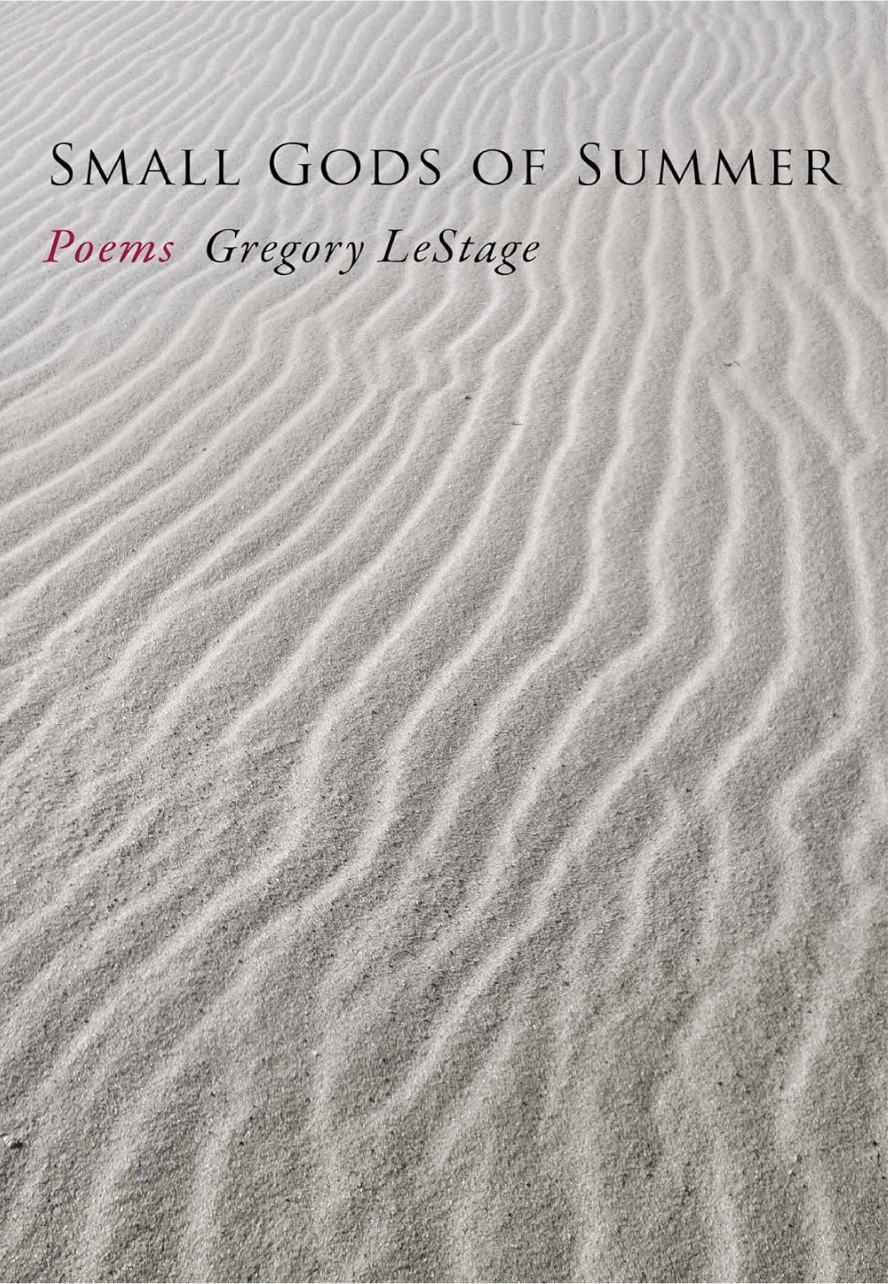
Small Gods Of Summer
In verse steeped in tradition but contemporary in its freedoms, Gregory LeStage's Small Gods of Summer presents an argument between opposites: the losses and griefs of a world gone dark are set against the joys and triumphs of a world bathed in light.
Rarely have the eye, heart and mind melded with such felicity as they do in this debut collection by Gregory LeStage. With elegantly textured language, these poems illuminate ‘a truth far too deep for gleaning’; they do so in meditations spiced with humor and grace, simultaneously pithy, witty and wise. Here are intelligence and honesty that never waver, percolating beneath the surface with all the intensity of a life truly examined.’
—Rodney Wittwer | Author of Gone & Gone
In Small Gods of Summer, Gregory LeStage looks wisely and unflinchingly at how the past influences the present, and vice versa. In carefully structured, vivid language, these poems walk the fine line between lyric and narrative; moments in time often have their own stories to tell, and here they’re told with LeStage’s unerring eye and ear. Rarely is so contemplative a book such a delight to read.
—Wyn Cooper | Author of Chaos is the New Calm
The tone of many of the poems in Small Gods of Summer struck me as occasional, though not so much to commemorate public events as to revisit personal events through memory and make them public markers, like a small town church, say. At first glimpse, I heard the expected rich language and sensory detail of memory, but on the second and third visits I found memory’s variations of gloss, truth, and foremost, memory’s reckoning with loss. It’s that quiet, cumulative reckoning that drew me closest, and then I looked straight up, taller than I thought.
– Scott Withiam | Author of Arson & Prophets
Small Gods Of Summer Reader Reviews:
“I don't know a whole lot about poetry. But I really like this book of poems. I like opening…to a random page when I want to take my brain someplace else for a minute. LeStage's poetry transports me to another physical place, or to an emotional place I have ignored, or into the minds of loved ones that I admire and I forget are all too human. Reading this book only makes me want to walk outside, stop and listen, and look and see, step and pause. But it also makes me think about the people in my life, who like me, have an interior life. All this given in eloquent and gorgeous pairings of words and spacing of lines. Find a quiet space and read it aloud. Or sit in a subway car and read it aloud in your head. I dare you not to be lifted.”
“Small Gods of Summer investigates the slippery nature of memory and experience, the truths and fictions of our lives, the burnished verse and the rust beneath…The poems are elegant and sophisticated. With a profound appreciation for free and structured verse, they are at the same time, highly accessible as they tell our own stories with illuminating detail…This is a small but powerful volume, with countless riches to quarry, memories to unearth, and secret selves to contemplate.”
“This is truly the only book of poetry I read again and again. I read it to revive my memories of childhood. I read it to be and stay in the moments of my children's childhood, my own fatherhood, and my parents' grand-parenthood. I read it to explore and examine the challenges, demons, and joys of life and relationships. While it feels like it was written just for me, I bet you will feel the same. Isn't that the mark of a genius work?”
“A lovely exploration of place, memory and identity. The title poem should be added to modern American poetry syllabi everywhere.”
“Gregory LeStage's Small Gods of Summer is a stirring, centered volume of poems about remembering, losing, loving, and inhabiting a natural world which both mirrors and draws out a human heart. Beginning with a boyhood joyously spent amidst rail tracks, dark teenage roads, field edges and well-known waterways, LeStage thematically arcs through young adulthood, marriage and family, the loss of elders, and travels. He returns again, in the final poem, to an ocean bay with "Delicate aster blossoms and salt marsh hay". Though deeply familiar from childhood, the bay now has "changing waters" and in these, he declares his intent to "stay/past the summer's end". Small Gods of Summer often has a physical earthiness like Seamus Heaney's, and the people inhabiting these poems are textured and richly conveyed-- LeStage's poem's evoke Phillip Levine's, if kinder in spirit.”
“The author captures the intriguing power of memory and it's effect on the human spirit in his poems exploring love, life and death. He has the amazing ability to get to the essence of these topics with a terrestrial and at the same time transcendental perspective.”