
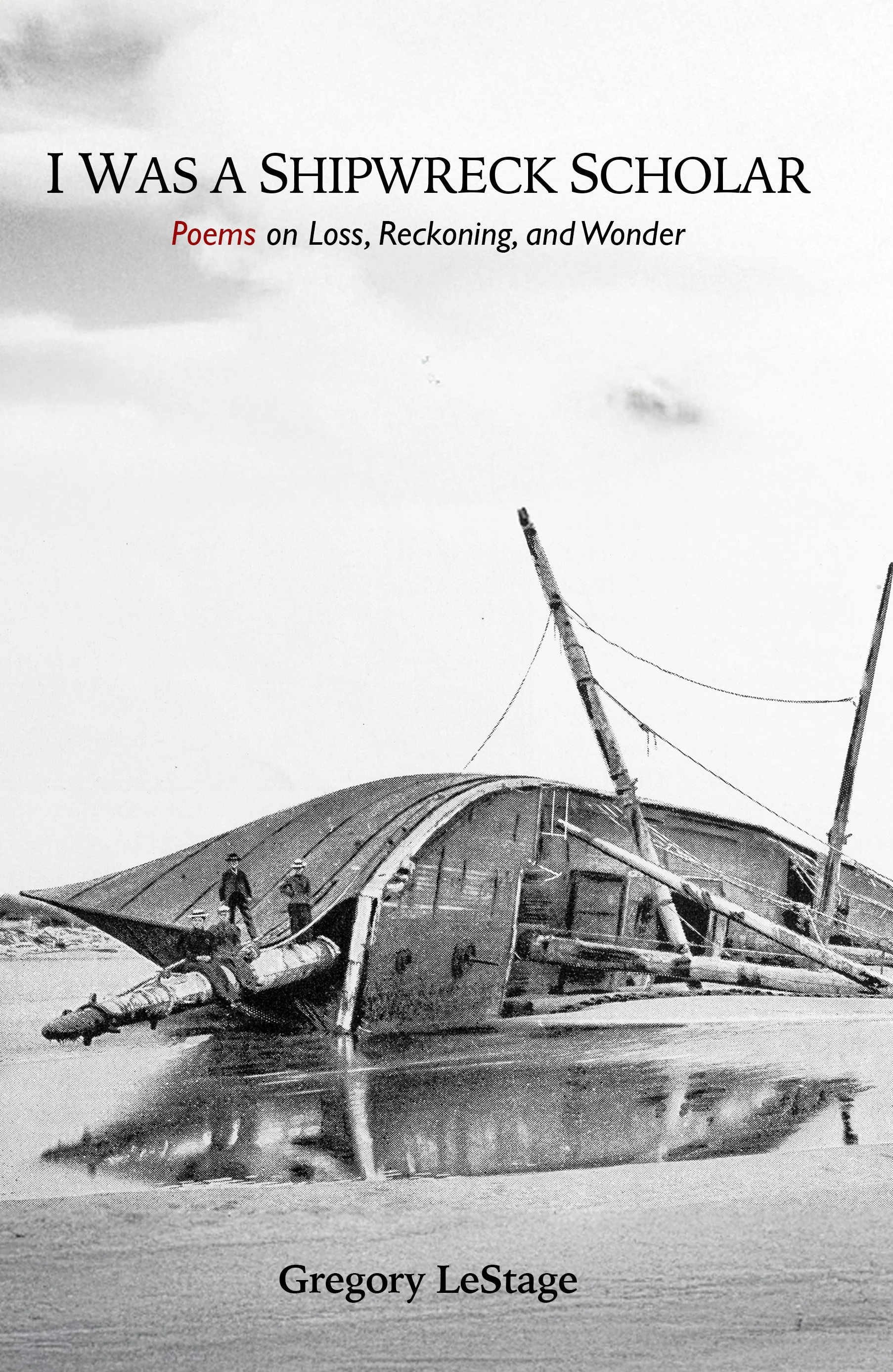
Gregory LeStage writes like a man who builds with his hands—carefully, deliberately, and with deep regard for what endures.
These poems explore memory, loss, and transformation through the lens of a life lived close to tools, tides, and time. They search for beauty in all things, even where and when it is not found. I Was A Shipwreck Scholar is for anyone who’s tried to hold on, let go, and make meaning from the wreckage.
A fascinating, poignant, and triumphant collection…
—Alexander Larman | Poetry Editor, The Spectator | Author of Lazarus and The Crown in Crisis
After tenderly burying a seal carcass near his seaside home, Gregory LeStage imagines digging it up years later, wiring its bones, and hanging it so it “moves with the breeze off the bay / like a seal remembering itself.” That image captures I Was a Shipwreck Scholar as a whole: an earthy poet rearticulating his own life on and near the Cape, animating moments from lived experience that might otherwise decompose and disappear. It’s a gift, this restoration; each poem seems to shimmer hauntingly in the salty Cape Cod air.
— Eben Harrell |Senior Editor, Harvard Business Review
Gregory LeStage’s poems move like weather – clearing, darkening, flashing suddenly with revelation. They remember what the land and water remember: that loss and beauty are the same tide, returning. This is a book of startling poise and compassion, as tender as it is exacting.
— Daniel Johnson | Executive Director, Mass Poetry | Author of How to Catch a Falling Knife and Shadow Act: An Elegy for Journalist James Foley
Read More by Gregory LeStage:
Praise for Hope Is A Small Barn:
Vaclav Havel wrote that hope was not just optimism that things will work out well, but rather a faith that what we do makes sense, regardless of the outcome. For Gregory LeStage, hope includes a child’s freshness of perception as he goes forth to discover the world. Hope for this poet also includes a deep commitment to assay both joy and sorrow, especially as these are met in family life unfolding over time. Underneath these is the hope that the shaping of words to express intense feeling is in itself worth our while and meaning-full. If, as LeStage tells us, hope is a small barn with a “roof half open to the sky,” here are poems that are crafted like sturdy beams, weight-bearing, reliable, and true.
— Fred Marchant | Author of Said Not Said
In Hope Is a Small Barn, Gregory LeStage returns our poetry to sonic elegance. The music inheres in LeStage’s poems, from syllable to syntax, and builds, like Rilke’s Orpheus, “a temple in the ear.” Each of these poems is an embodiment, a shapely figure for the poet’s concerns, which are those of maturity: love and its responsibilities, mortality and its abiding questions. There is great nourishment to be found in these beautifully crafted poems.
— Richard Hoffman | Author of Gold Star Road
“Words matter” says poet Gregory LeStage in the preface to his newest book, Hope Is a Small Barn, and then proceeds to prove the point. Each word in this intelligent collection of poems is precisely placed, each carefully crafted for sound, associations, beats, even, once, to form a visual image on the page. The collection starts with the experiences of the poet as a boy of ten and then oscillates over and through his life, always returning “to someone we all once were /some child or safe self long gone.” This fine new book takes us deep into the mind of an accomplished poet as he struggles to “make my peace with all / that I could never understand / by reckoning through the archive of the inexplicable” Poetry at its best is, indeed, our struggle with the inexplicable. We are all the wiser for this poet's struggle and for the beautiful, thoughtful, poems that have flowed from it.
Michael Ansara | Founder & Chairman of Mass Poetry
Rarely have the eye, heart and mind melded with such felicity as they do in this debut collection by Gregory LeStage. With elegantly textured language, these poems illuminate ‘a truth far too deep for gleaning’; they do so in meditations spiced with humor and grace, simultaneously pithy, witty and wise. Here are intelligence and honesty that never waver, percolating beneath the surface with all the intensity of a life truly examined.’
— Rodney Wittwer | Author of Gone & Gone
In Small Gods of Summer, Gregory LeStage looks wisely and unflinchingly at how the past influences the present, and vice versa. In carefully structured, vivid language, these poems walk the fine line between lyric and narrative; moments in time often have their own stories to tell, and here they’re told with LeStage’s unerring eye and ear. Rarely is so contemplative a book such a delight to read.
—Wyn Cooper | Author of Chaos is the New Calm
The tone of many of the poems in Small Gods of Summer struck me as occasional, though not so much to commemorate public events as to revisit personal events through memory and make them public markers, like a small town church, say. At first glimpse, I heard the expected rich language and sensory detail of memory, but on the second and third visits I found memory’s variations of gloss, truth, and foremost, memory’s reckoning with loss. It’s that quiet, cumulative reckoning that drew me closest, and then I looked straight up, taller than I thought.
– Scott Withiam | Author of Arson & Prophets
Praise for Small Gods Of Summer:
