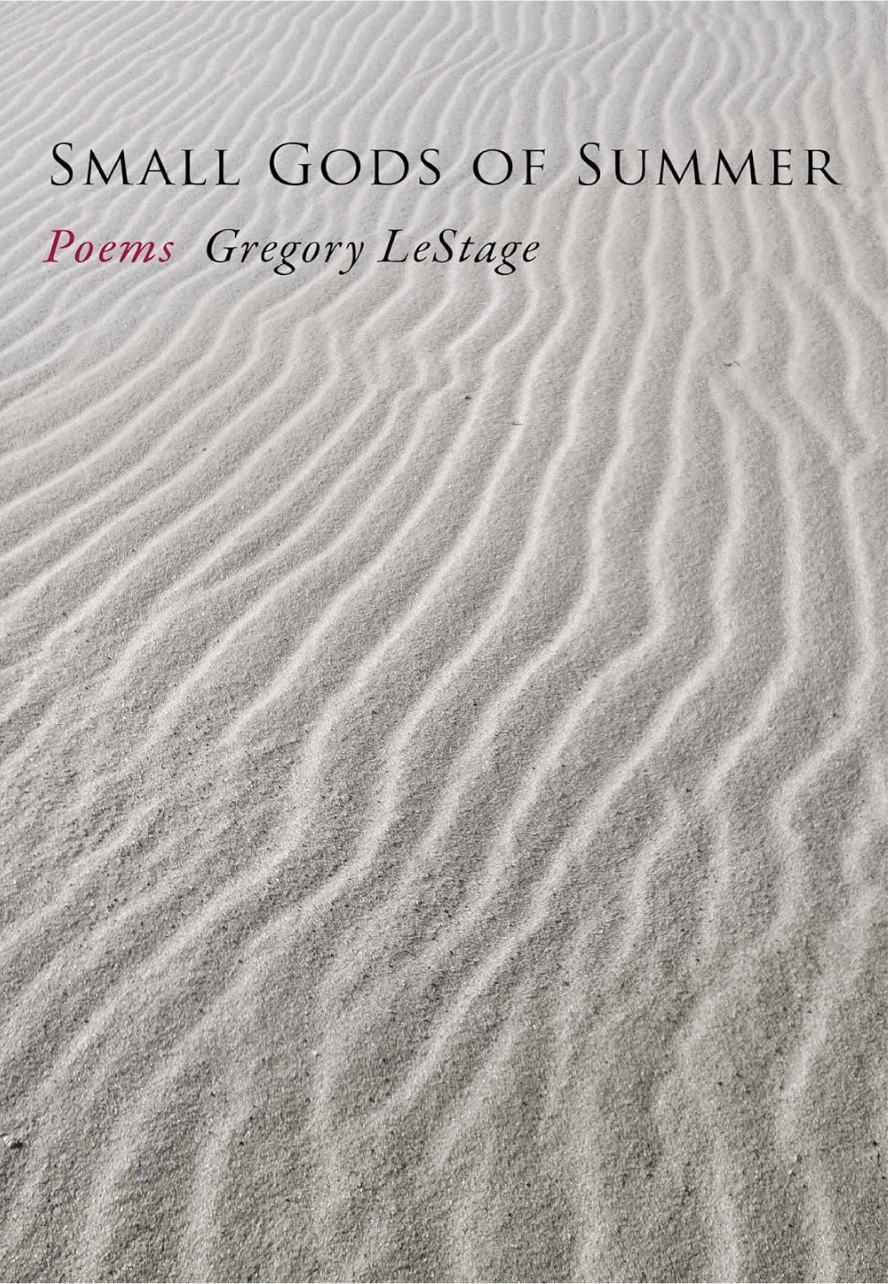
Small Gods Of Summer
In verse steeped in tradition but contemporary in its freedoms, Gregory LeStage's Small Gods of Summer presents an argument between opposites: the losses and griefs of a world gone dark are set against the joys and triumphs of a world bathed in light.
Rarely have the eye, heart and mind melded with such felicity as they do in this debut collection by Gregory LeStage. With elegantly textured language, these poems illuminate ‘a truth far too deep for gleaning’; they do so in meditations spiced with humor and grace, simultaneously pithy, witty and wise. Here are intelligence and honesty that never waver, percolating beneath the surface with all the intensity of a life truly examined.’
— Rodney Wittwer | Author of Gone & Gone
In Small Gods of Summer, Gregory LeStage looks wisely and unflinchingly at how the past influences the present, and vice versa. In carefully structured, vivid language, these poems walk the fine line between lyric and narrative; moments in time often have their own stories to tell, and here they’re told with LeStage’s unerring eye and ear. Rarely is so contemplative a book such a delight to read.
—Wyn Cooper | Author of Chaos is the New Calm
The tone of many of the poems in Small Gods of Summer struck me as occasional, though not so much to commemorate public events as to revisit personal events through memory and make them public markers, like a small town church, say. At first glimpse, I heard the expected rich language and sensory detail of memory, but on the second and third visits I found memory’s variations of gloss, truth, and foremost, memory’s reckoning with loss. It’s that quiet, cumulative reckoning that drew me closest, and then I looked straight up, taller than I thought.
– Scott Withiam | Author of Arson & Prophets
Small Gods Of Summer Reader Reviews:
“I don't know a whole lot about poetry. But I really like this book of poems. I like opening…to a random page when I want to take my brain someplace else for a minute. LeStage's poetry transports me to another physical place, or to an emotional place I have ignored, or into the minds of loved ones that I admire and I forget are all too human. Reading this book only makes me want to walk outside, stop and listen, and look and see, step and pause. But it also makes me think about the people in my life, who like me, have an interior life. All this given in eloquent and gorgeous pairings of words and spacing of lines. Find a quiet space and read it aloud. Or sit in a subway car and read it aloud in your head. I dare you not to be lifted.”
“Small Gods of Summer investigates the slippery nature of memory and experience, the truths and fictions of our lives, the burnished verse and the rust beneath…The poems are elegant and sophisticated. With a profound appreciation for free and structured verse, they are at the same time, highly accessible as they tell our own stories with illuminating detail…This is a small but powerful volume, with countless riches to quarry, memories to unearth, and secret selves to contemplate.”
“This is truly the only book of poetry I read again and again. I read it to revive my memories of childhood. I read it to be and stay in the moments of my children's childhood, my own fatherhood, and my parents' grand-parenthood. I read it to explore and examine the challenges, demons, and joys of life and relationships. While it feels like it was written just for me, I bet you will feel the same. Isn't that the mark of a genius work?”
“A lovely exploration of place, memory and identity. The title poem should be added to modern American poetry syllabi everywhere.”
“Gregory LeStage's Small Gods of Summer is a stirring, centered volume of poems about remembering, losing, loving, and inhabiting a natural world which both mirrors and draws out a human heart. Beginning with a boyhood joyously spent amidst rail tracks, dark teenage roads, field edges and well-known waterways, LeStage thematically arcs through young adulthood, marriage and family, the loss of elders, and travels. He returns again, in the final poem, to an ocean bay with "Delicate aster blossoms and salt marsh hay". Though deeply familiar from childhood, the bay now has "changing waters" and in these, he declares his intent to "stay/past the summer's end". Small Gods of Summer often has a physical earthiness like Seamus Heaney's, and the people inhabiting these poems are textured and richly conveyed-- LeStage's poem's evoke Phillip Levine's, if kinder in spirit.”
“The author captures the intriguing power of memory and it's effect on the human spirit in his poems exploring love, life and death. He has the amazing ability to get to the essence of these topics with a terrestrial and at the same time transcendental perspective.”